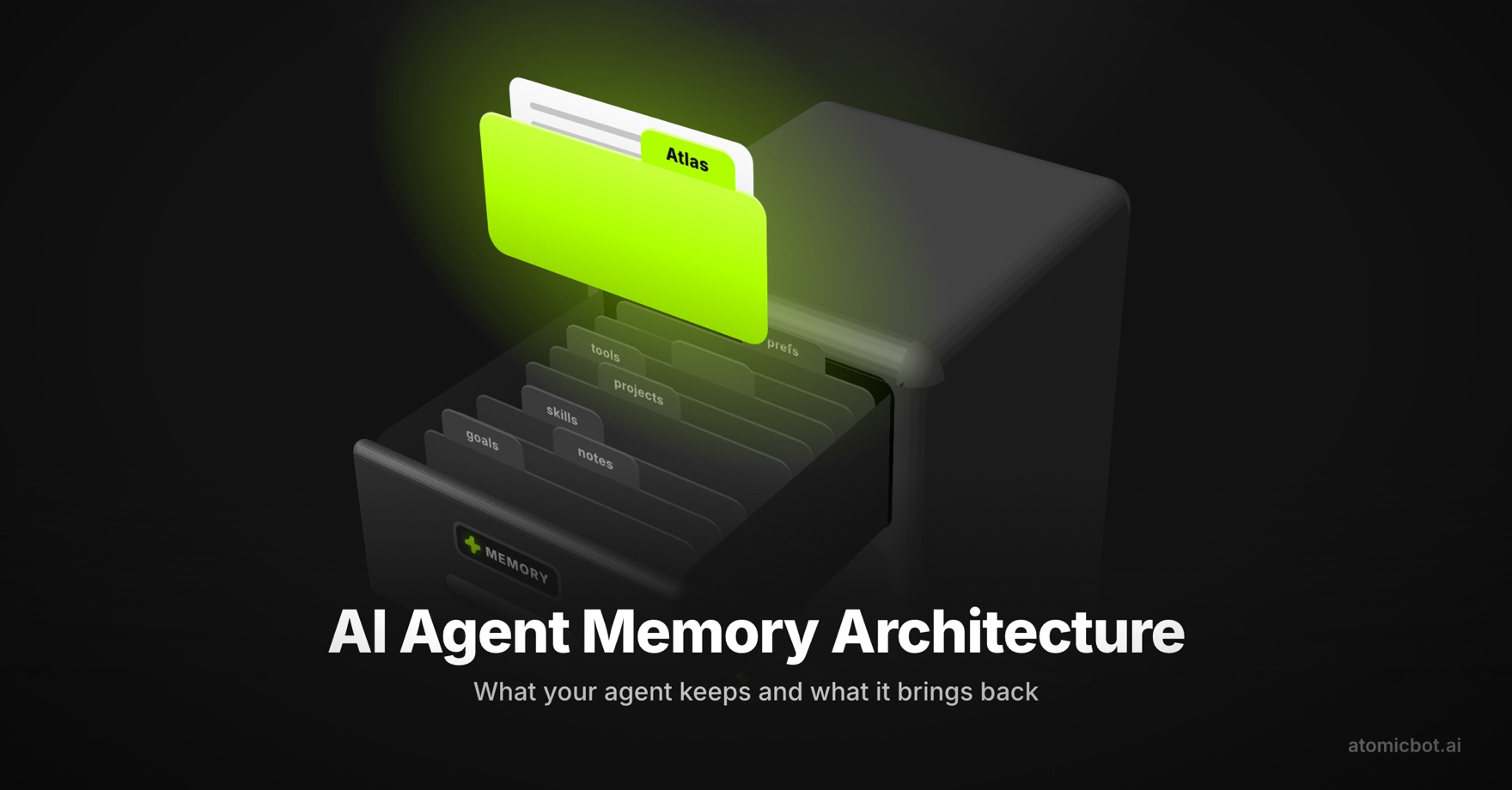
How AI agent memory works: what to persist across sessions, where to store it, how retrieval filters it, and why permissions belong in the design.
Codex and Claude Code solve 190 and 191 of the same 303 benchmark tasks. How they differ on price per task, usage limits, uptime and behaviour.
Jev is TypeSafe AI's System One model: typed decisions with calibrated probabilities in under a second, not text. How it works, pricing, and limits.
OpenClaw 2.0 moves your sessions into SQLite, and the warning about it is easy to miss. What changed, what breaks, and how to update without losing your history.
OpenClaw hosting in 2026: managed platforms, VPS and self-hosting compared, with real prices, renewal rates and documented requirements.
Hermes reads your Obsidian vault before you install anything. Three ways to connect them, which of the two plugins fits, and how to keep the agent out of notes it shouldn't touch.
DeepSeek Harness (dsh): an open-source agent harness where even the agent loop is a plugin. What it does, what it doesn't, and whether it's ready to use.
SpaceXAI's always-on agents cost $120 to $300 a month, and most launch coverage got the architecture backwards: your bots do not get a computer each. What Grok Bot actually does, what it costs, and what to run instead.
The best OpenClaw alternatives in 2026, compared by what they actually replace – Hermes, NanoClaw, Codex, Claude Cowork and more. Two you can try in one click.
Six ways to host OpenClaw in 2026, compared on price and specs: Contabo, Atomic Bot, Vultr, DigitalOcean, Hetzner, and Oracle.
NVIDIA's Nemotron 3 Ultra costs 10x less than GPT-5.5 and gets surprisingly close on practical tasks. We tested both with real physics simulations, pulled the official benchmarks, and break down honestly where GPT-5.5 still wins.

.svg)