.svg)



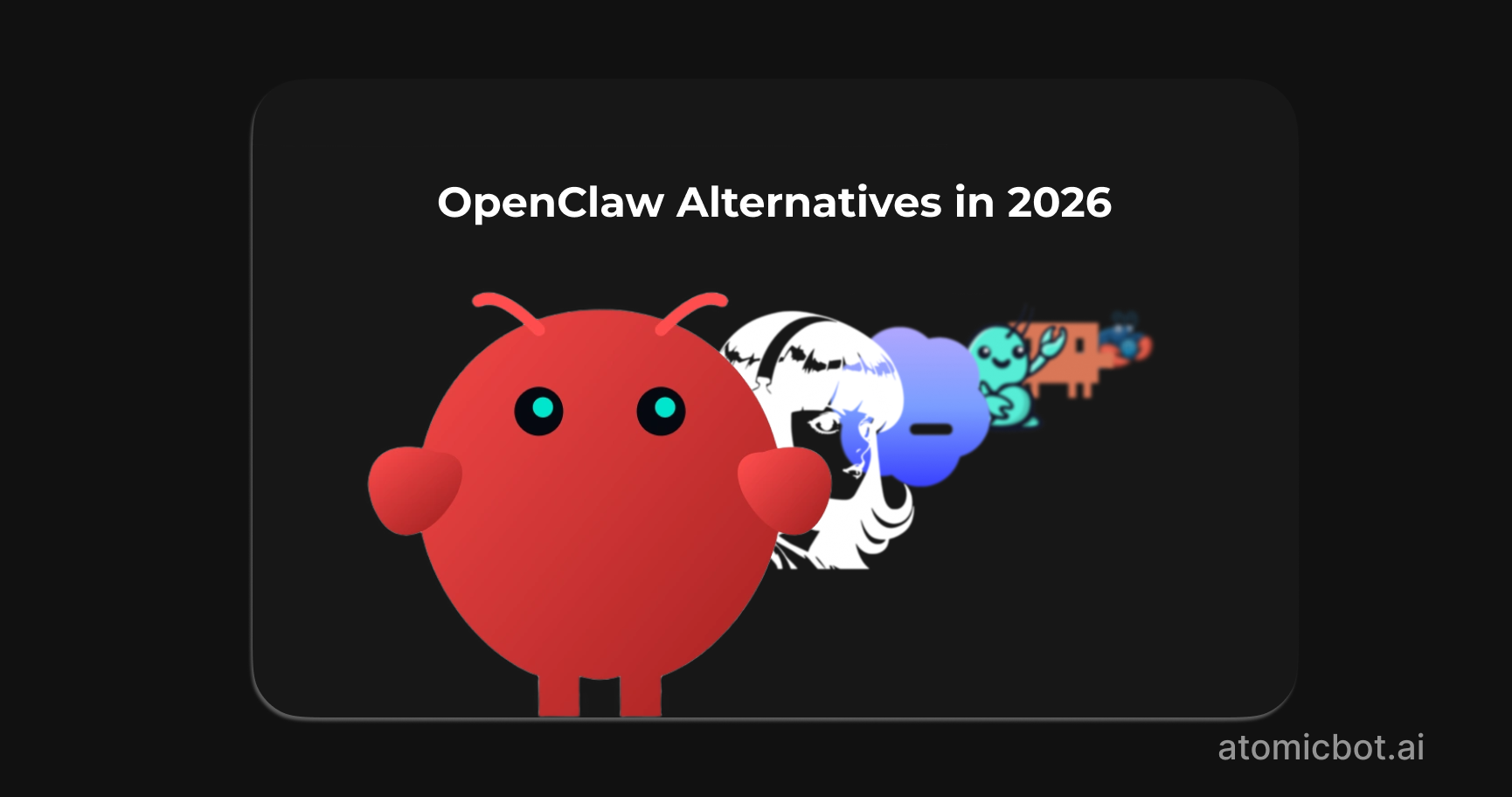
OpenClaw won 2026. With more than 385,000 GitHub stars it is now the most-starred software project on the platform, ahead of React and Linux, and it did that in about eight months.
It also produced the largest population of people in AI who love a tool and want to stop running it.
If you are searching for OpenClaw alternatives, you almost certainly are not asking "what is an AI agent." You have installed it, or tried to. Something specific pushed you here – a security advisory, an API bill, a gateway that stopped starting after an update, or the slow realization that you wanted a coding assistant and accidentally built a home server.
This guide is organised around that. Not ten agents ranked by nothing in particular, but a short list sorted by what you are actually replacing – with honest notes on where OpenClaw still wins.
🎯 Quick answer
- The closest like-for-like OpenClaw alternative is Hermes Agent – same shape (self-hosted, model-agnostic, messaging-first), MIT-licensed, with a self-improving skill loop instead of a public skill marketplace.
- If your objection is security, look at NanoClaw – container isolation by default, so the agent's file and command access is sandboxed rather than running loose on your host.
- If your objection is weight, look at ZeroClaw, nanobot or PicoClaw – small, readable projects that run on hardware OpenClaw struggles on. All are young; treat them as experiments before you point them at your inbox.
- If you never want to run infrastructure, look at Atomic Bot – managed cloud hosting, agent runs 24/7, zero setup.
- And for a large group, the fix is not a different agent at all – it is a different way of running the one you already like. More on that below.
Why people are looking for OpenClaw alternatives in 2026
Five triggers come up repeatedly across security reporting, changelogs and community threads. They matter because they point at different alternatives – a security refugee and a cost refugee should not end up on the same product.
.png)
1. Security, and the ClawHub problem
This is the most-cited reason to leave, and the most legitimate.
OpenClaw runs with broad access to your machine by design: files, shell, browser, credentials. When that design meets a project shipping at OpenClaw's pace, you get vulnerabilities. February and March 2026 brought a cluster of disclosures, the most severe being CVE-2026-25253 – a one-click remote code execution flaw rated 8.8 that let an attacker who got you to click a link take over your agent, patched in release 2026.1.29. A separate advisory in March pushed users to upgrade the Gateway urgently and audit every credential they had handed to an agent instance.
The skill marketplace added a second surface. Skills are code, and ClawHub distributes them the way a package manager distributes libraries – which means a poisoned skill is a supply-chain attack. Security researchers have flagged batches of malicious skills, and CertiK publicly advised inexperienced users to wait for stronger safeguards.
None of this makes OpenClaw a bad project. It makes it a young, enormous, fast-moving one – and if you are running it on a machine that holds anything sensitive, that is a real risk calculation.
2. The bill nobody budgeted for
An autonomous agent calls models on its own schedule. That is the entire point, and it is also why people wake up to charges they did not authorise in any conscious sense. Community reports of an idle-ish setup burning through several dollars a day are common enough to be a genre, and one runaway loop can drain a monthly budget across multiple providers in a weekend.
Model costs are a separate consideration. Anthropic’s policies around using Claude through third-party agents changed several times in 2026, so the exact subscription and API rules are worth checking before you build a workflow around them. More importantly, your model choice affects your bill far more than your agent choice does. Switching from OpenClaw to Hermes while keeping the same model and task volume will not magically make inference cheap. Switching models, routing routine work to a cheaper provider, or moving some workloads to local models can make a much larger difference.
3. Setup, updates, and the maintenance tax
The install is a real barrier – Node, Docker, gateway config, API keys, channel tokens – and it is not a one-time cost. OpenClaw ships constantly, and shipping constantly means occasional regressions. "The gateway won't start after the last two updates" is a recognisable complaint in community threads through mid-2026.
If this is your only objection, note that it is an operations problem, not an agent problem. Changing agents swaps one install for another. Changing how you run it is the actual fix.
4. Weight
OpenClaw is a large TypeScript codebase with desktop heritage. It runs headless fine, but it is not what you reach for on a Raspberry Pi, a $4 VPS, or a five-year-old laptop. If your constraint is hardware, the lightweight rewrites exist precisely for you.
5. It was the wrong shape
A meaningful share of people who bounce off OpenClaw wanted one of two things: an agent that writes code, or an assistant somebody else hosts. OpenClaw is neither. It is a self-hosted personal agent that lives in your messaging apps. If that description does not match the job you had in mind, no fork of it will either.
First, decide what you are actually replacing
Most "OpenClaw alternatives" lists fail here. They put a container-isolated fork, a managed cloud agent, and a coding assistant in one ranking, as though picking between them is a matter of preference. It is not – they do different jobs.
Three shapes cover almost every real case:
OpenClaw alternatives compared at a glance
Two things worth reading off that table.
First, five of these seven are not available in Atomic Bot – that column is a fact, not a recommendation. Second, notice how often "what costs money" says your token usage. Open-source agents are free software attached to a metered API. That is the cost model you are actually choosing.
The expensive part of using this table is not the decision. It is the testing – three agents properly evaluated is a weekend of installs, and most people give up after the first. OpenClaw and Hermes both run inside Atomic Bot from the same interface, locally or in the cloud, so comparing them costs an afternoon instead.
The closest open-source alternatives to OpenClaw
Hermes Agent – the closest like-for-like swap
What it is: an open-source agent runtime from Nous Research, MIT-licensed, launched in early 2026 and now one of the most-starred agent projects on GitHub with well over 225,000 stars.
Why an OpenClaw user considers it: it is the same shape. Self-hosted, model-agnostic, reachable from Telegram, Discord, Slack, WhatsApp, Signal or the CLI, with scheduled jobs and subagents. You are not learning a new category – you are swapping the engine.
What is actually different: OpenClaw persists memory between sessions through workspace files and its memory system. Hermes takes a different approach: it combines persistent memory with a reflective loop that can create and reuse skills from completed work.
That difference has a security consequence people underrate. Hermes does not rely on a public skill marketplace for its self-improvement loop. Its generated skills are created locally rather than downloaded from a central marketplace.
Strengths: self-improving on recurring work; six execution backends including SSH, Modal and Docker; genuinely portable model config; runs on a $5 VPS.
Weaknesses, honestly: it is young, and breaking changes still land between releases. The skill ecosystem is a fraction of ClawHub's, so day one is slower – you write more glue yourself. And self-improving is not self-correcting: if a skill encodes a wrong assumption, it will happily reuse it. Spot-check what it writes for the first month.
Try it: Hermes runs one-click in Atomic Bot – local or cloud, your own API keys or a free local model, with a dashboard, terminal, logs and file explorer, and none of the gateway YAML.
On the mirror-image question. People searching for Hermes agent alternatives are usually asking the reverse of this article: they want Hermes's memory model but a bigger ecosystem, or they hit an install edge case and want out. The honest answer there is short – OpenClaw is the closest alternative to Hermes, for exactly the reasons Hermes is the closest alternative to OpenClaw. Which is why a growing number of people stop choosing and run both.
NanoClaw – when the objection is security
A TypeScript fork built around container isolation. The agent runs inside containers, so its file and command reach is bounded by the container rather than by your host's permissions. For anyone handling data where "the agent had shell access" is an unacceptable sentence in an incident report, that is the right architecture.
Trade-offs: it is container-runtime focused rather than dashboard-first, so expect basic logs rather than polished observability, and expect to know your way around containers. The skill ecosystem is far smaller than OpenClaw's.
Pick it if: you are connecting an agent to messages, files or personal data in a regulated or shared environment and you want the reach contained by design.
ZeroClaw – when the objection is weight
A Rust rewrite that trades OpenClaw's breadth for a tiny footprint: a binary measured in megabytes, memory measured in single-digit megabytes for long-running agents, and startup fast enough to run on a single-board computer. If your agent lives on a Pi, an old NAS or the cheapest VPS tier, this is the one that actually fits.
A note on the coverage: some articles describe ZeroClaw primarily as a zero-trust security project and others as a performance rewrite. Read the current repository before you decide which claim you are buying.
nanobot and PicoClaw – when you want to read the whole thing
Both are minimal implementations – a few thousand lines of readable code, native MCP support in nanobot's case, a single binary in PicoClaw's. The appeal is comprehension: you can hold the entire agent in your head and change it.
The caveat that belongs on all of these lightweight projects: they are young and largely unvalidated in production. Regulars in r/LocalLLaMA treat the fork family as experimental, and that is a fair read. Use them where a failure is annoying rather than expensive.
What actually transfers when you switch
This is the section every other comparison skips, and it is the one that costs people a weekend.
These are separate projects, not different builds of the same thing. An OpenClaw skill does not necessarily run on nanobot. A ZeroClaw config will not match PicoClaw's. Channel support, config format and the skill contract all differ per project.
What does carry over:
- Your model setup. Every option in this family is bring-your-own-key. Provider config differs, but the freedom does not.
- Your accounts and tokens. Telegram bot tokens, Slack apps, Discord webhooks – you re-point them, you do not re-create them.
- Your habits. The mental model of "message an agent, it does the thing" is identical everywhere.
What does not transfer automatically:
- Your skills, in most cases. Each project has its own skill system and runtime conventions, so moving custom skills between OpenClaw alternatives can require manual adaptation. Hermes is an exception: its official
hermes claw migratecommand can import user-created OpenClaw skills into~/.hermes/skills/openclaw-imports/, along with memories,SOUL.md, USER.mdand command allowlists. - Your gateway config. Even when migration tooling exists, agent-specific gateway and infrastructure settings may need to be translated or reviewed.
- Community answers. Every troubleshooting thread you have bookmarked is about a different project now.
Hermes ships a migration command that brings OpenClaw settings across, which makes it the cheapest switch in the group. The forks do not.
Managed alternatives if you never want to run infrastructure
Claude Cowork
Anthropic's desktop agent, generally available since April 2026 and available through paid Claude plans, with access and limits depending on the plan. It reads your files, runs scheduled and recurring tasks, has a plugin marketplace, and hands work back when it is done.
Why an OpenClaw user considers it: zero infrastructure, no gateway, no CVE watch, and a security model where the vendor owns the problem.
What you give up: model choice (Anthropic only), self-hosting, and the messaging-gateway surface. There is no "text your agent on WhatsApp." If OpenClaw's appeal was that it lived in the same app as your friends, Cowork will feel like a different product – because it is.
Pick it if: the work is documents, research, analysis and file wrangling on a machine you sit at.
If you actually wanted a coding agent
Codex
What it is: OpenAI's coding agent, available on the web, in a VS Code extension, in the CLI, on iOS and via Amazon Bedrock. It takes a task, works in a sandbox, and returns code, logs and test results. It handles GitHub integration, automatic PR review, and parallel task delegation – fire off several jobs, check back later.
Pricing model: there is no standalone Codex subscription. Codex is included with eligible ChatGPT plans, with usage limits and token-based credits varying by plan and workload. Codex now uses token-based credits, with limits and credit rates varying by plan and workload.
How it differs from OpenClaw: completely. Codex has no messaging gateway, no personal-assistant surface, no local file organisation, no Telegram. It will not read your email. What it does is write and review code better than a general-purpose agent, in an environment built for that.
The interesting wrinkle: these two are increasingly not either/or. Recent OpenClaw releases improved Codex delegation and added openclaw attach, letting a coding agent take temporary access to a session. The emerging pattern is OpenClaw as the interface and scheduler, a coding agent as the specialist underneath.
🚀 Codex is available now in Atomic Bot
→ Create your free account and be first to try Codex
Claude Code
The other serious coding-first option: terminal-native, strong model quality, human-in-the-loop approval, from $20/month. We have already put it head to head with OpenClaw in detail – see OpenClaw vs Claude Code rather than a summary here.
Which OpenClaw alternative should you choose?
- "Security pushed me out." → Hermes if you want the same breadth with no downloadable-skill surface. NanoClaw if you need the agent's reach contained at the runtime level.
- "My API bill is out of control." → Change the model before you change the agent. Route routine work to a cheaper or local model, then reassess. If you still want to switch, Hermes gets faster at repeated tasks, which lowers tokens per job over time.
- "I cannot keep maintaining this." → A managed agent (Claude Cowork) if you can live inside one vendor. A managed runner if you want to keep open-source agents – Atomic Bot's cloud mode covers the uptime without taking your model choice away.
- "It is too heavy for my hardware." → ZeroClaw, or nanobot/PicoClaw if you also want to read the source.
- "I only wanted code." → Codex if you are in the OpenAI ecosystem, Claude Code if you are in Anthropic's.
- "I want the best of both." → Run OpenClaw as the gateway and Hermes as the brain. That combination is genuinely common now, and we have written up the workflow patterns that work.
Where OpenClaw still wins
Worth stating clearly, because most alternatives articles are commercially motivated not to:
- The largest integration surface in the category. If a tool exists, someone has wired it up.
- ClawHub. Whatever its security record, a real package manager with thousands of skills is a genuine advantage that no fork has replicated.
- The most messaging channels, and the most battle-tested implementations of them.
- MIT-licensed, with no vendor between you and your data, now under foundation governance after Peter Steinberger joined OpenAI in February 2026.
- The biggest community. 2,500+ contributors means every problem you hit has probably been hit already.
If your objection was setup or hosting rather than the software itself, staying and changing your deployment is a completely reasonable answer.
The part most comparisons skip: where it runs
Every agent on this list that you self-host has the same unglamorous requirement – it has to be on. An agent that only works while your laptop is open is not an assistant, it is a demo.
Three practical paths:
Local. Maximum privacy, zero hosting cost, and your data never leaves the machine. Fine for a workstation that stays awake; frustrating on a laptop. If you are going this route, our platform guides for Mac and Windows cover the details, and the system requirements breakdown is more realistic than the numbers you will see quoted around the web.
A VPS. Always-on, cheap, and the standard answer for anyone serious. The costs are a few euros a month plus the time you spend being your own sysadmin – patching, monitoring, restarting the gateway, and staying current with security releases. That last one is not optional given the disclosure history.
Managed. Somebody else's uptime. The version worth knowing about is the one that does not cost you your model choice: Atomic Bot's cloud runs OpenClaw or Hermes on our infrastructure with a Google sign-in, while you keep bring-your-own-key model selection and can switch providers whenever you want. Local, cloud, or a hybrid, depending on what you are running and how sensitive it is.
That is the honest position of this article: for a large share of people searching for OpenClaw alternatives, the software was never the problem. The DevOps was. Changing agents does not fix that – it just moves the install.
Frequently asked questions
What is the closest alternative to OpenClaw? Hermes Agent. It is the only project with the same shape – self-hosted, model-agnostic, messaging-first, MIT-licensed – at comparable maturity. It also ships a migration command that brings OpenClaw settings over, which no fork offers.
Is Hermes better than OpenClaw? Neither is universally better. Hermes wins on recurring work, memory and skill-supply-chain safety. OpenClaw wins on breadth, integrations, channels and community size. If your workflows change often, Hermes compounds. If you need maximum coverage today, OpenClaw still has it.
Are the OpenClaw forks safe to use in production? NanoClaw's container isolation is a genuine architectural improvement over running an agent on your host. But the fork family as a whole – ZeroClaw, PicoClaw, nanobot and others – is young and largely unvalidated in production. Treat "more secure by design" and "proven in production" as separate claims.
Can Codex replace OpenClaw? Only if the work you gave OpenClaw was code. Codex has no messaging gateway, no email or calendar access and no personal-assistant surface. For repository work it is stronger; for everything else it is not a substitute.
Do my OpenClaw skills work in other agents? Not automatically across the whole OpenClaw-alternative ecosystem. Each agent has its own skill format, configuration and runtime conventions, so skills may require adaptation when moving between projects. Hermes is the important exception: its official hermes claw migrate command can import user-created OpenClaw skills from ~/.openclaw, placing them under ~/.hermes/skills/openclaw-imports/. The migration also carries over memories, SOUL.md, USER.md and command allowlists.
Is there a free OpenClaw alternative? Most of them. Hermes, NanoClaw, ZeroClaw, nanobot and PicoClaw are all free and open source. You pay for the tokens your agent consumes, and for whatever you run it on. The managed options – Cowork, Manus, Kimi Claw, Codex – all require a subscription.
Is there a hosted version of OpenClaw? Yes. Atomic Bot runs OpenClaw and Hermes either locally on your machine or in the cloud, without terminal setup, Docker or gateway configuration – you keep your own model provider and API keys.
Final word
The question people actually have is narrower: what am I replacing? If the answer is "a self-hosted personal agent that behaves better," Hermes is your first stop and NanoClaw your second. If it is "the infrastructure," a managed option or a managed runner solves it and no fork will. If it is "I wanted code," Codex and Claude Code were always the right category.
And if the answer is "nothing, actually – I just want this to be less work," that is worth admitting too. OpenClaw is still the broadest agent in the space. Running it without the setup is a smaller change than migrating everything you built.